

by Barbara Heninger, Properties Manager and SBMT Historian
Theatre gives us many ways to be creative. Besides performing, I enjoy designing props for shows, and have created props for several of South Bay Musical Theatre’s shows (Peter and the Starcatcher, The Sound of Music, and No, No, Nanette). In SBMT’s upcoming production of Little Women, I not only get to play crusty old Aunt March, I am also designing the props!
Property design includes providing all of the many ‘hand props’ that characters carry, exchange, and interact with. This might be a fan for the March girls to go to a ball, a feathered hat for Jo’s home theatricals, or a blanket to wrap Amy after she’s pulled from an icy pond. It also encompasses the set décor, so that I help our set designer, Michael Hirsch, choose furniture, and I also “decorate” the set with various items like sewing kits, old-fashioned wooden skates, books (of course!), photographs of the March family, plants and flowers, dolls and toys, and more.
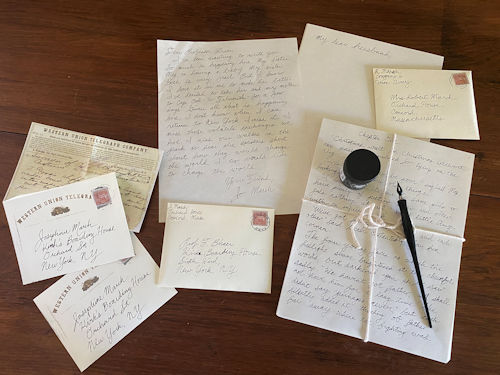
Letters and stories hand-written for Little Women
Writing Stories for Jo
But I’m having the most fun providing the many, MANY printed materials the characters use. Since Little Women is the story of a young writer, and since the story is set in 1863-1865, it’s not surprising that there are several hand-written stories and letters. To create these, I pulled out my bottle of India ink and my old-fashioned calligraphy pens and wrote out all of the letters and stories by hand on parchment-style paper. I even wrote the pages of the story that Amy burns based on a story Louisa May Alcott included in Little Women – and then partially burned them. I also wrote out the first two pages and last page of Jo’s manuscript for the book, Little Women, which appears at the end (confession: the rest are blank pages!), copying the text exactly as it appears in the real book. I can tell you that, just as noted in the book, you can identify a writer by the ink-stain on the middle finger of their writing hand!
The 1860s means no telephones (patented in the 1870s) or Internet, so the characters contact each other through many letters that are “written” and read on stage. I took care to write the letters as they are quoted onstage, and tried to vary my handwriting from my old grade-school cursive. I made up addresses for the envelopes, putting the March family in the Alcott’s real home at Orchard House in Concord. To make the envelopes look more real, I found images of stamps from the period, printed some stamp-sized color copies, cut them out and glued them onto the envelopes, “cancelling” them with hand-drawn lines. My Western Union telegram features the proper period heading and logo on the envelope, and the telegram inside is a facsimile of a real one (this is the only printed item that doesn’t actually say what the actor “reads”).
Why does this matter? Because when the actors interact with these props, it feels ‘real’ to both them and the audience, and we experience a more authentic performance. And it’s just fun to do!
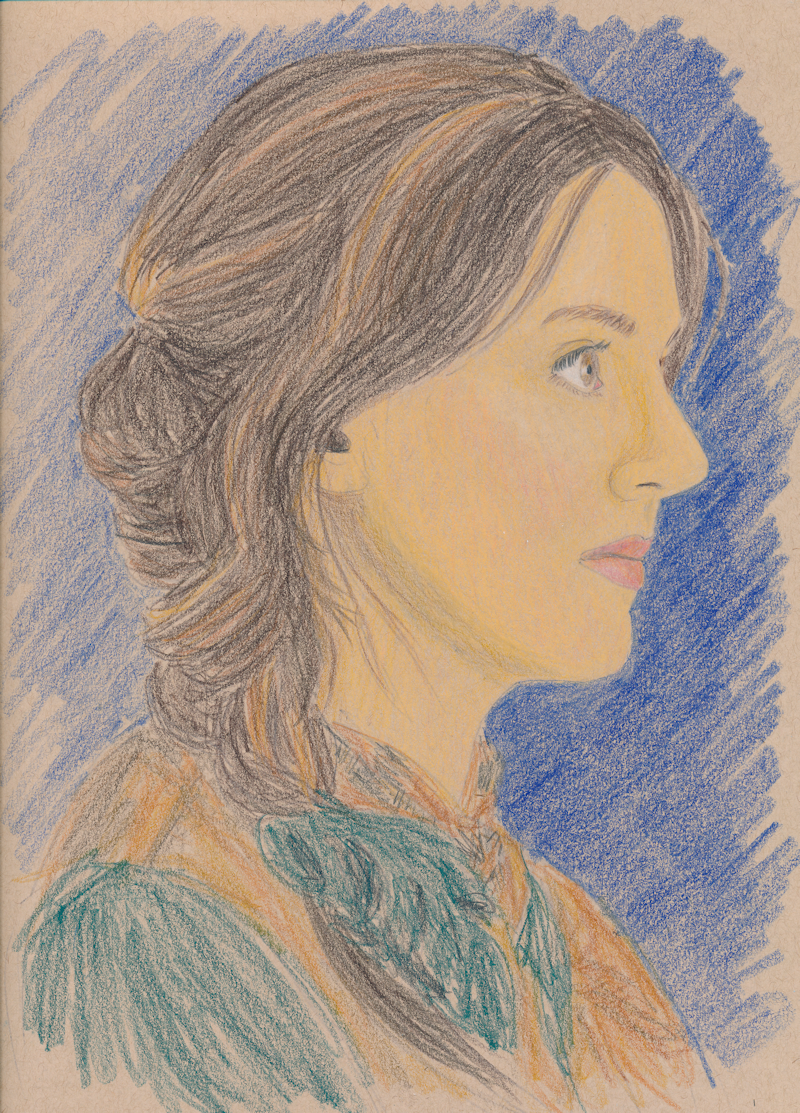
Pencil sketch transferred to tan art paper and hand-colored
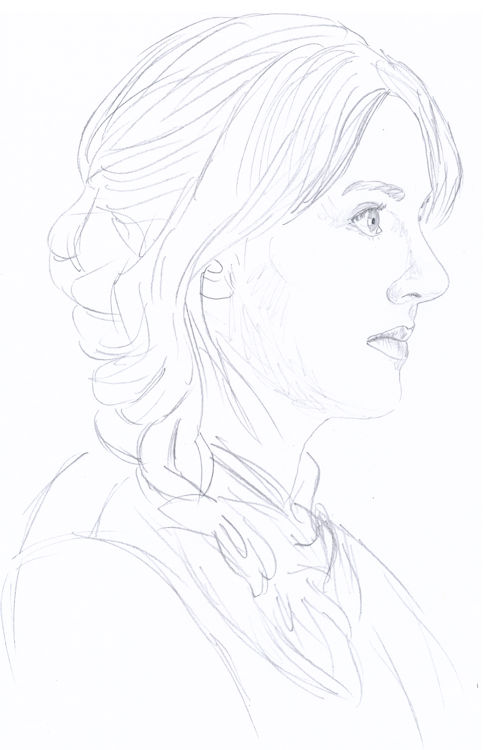
Pencil sketch of Brenna copied from photo
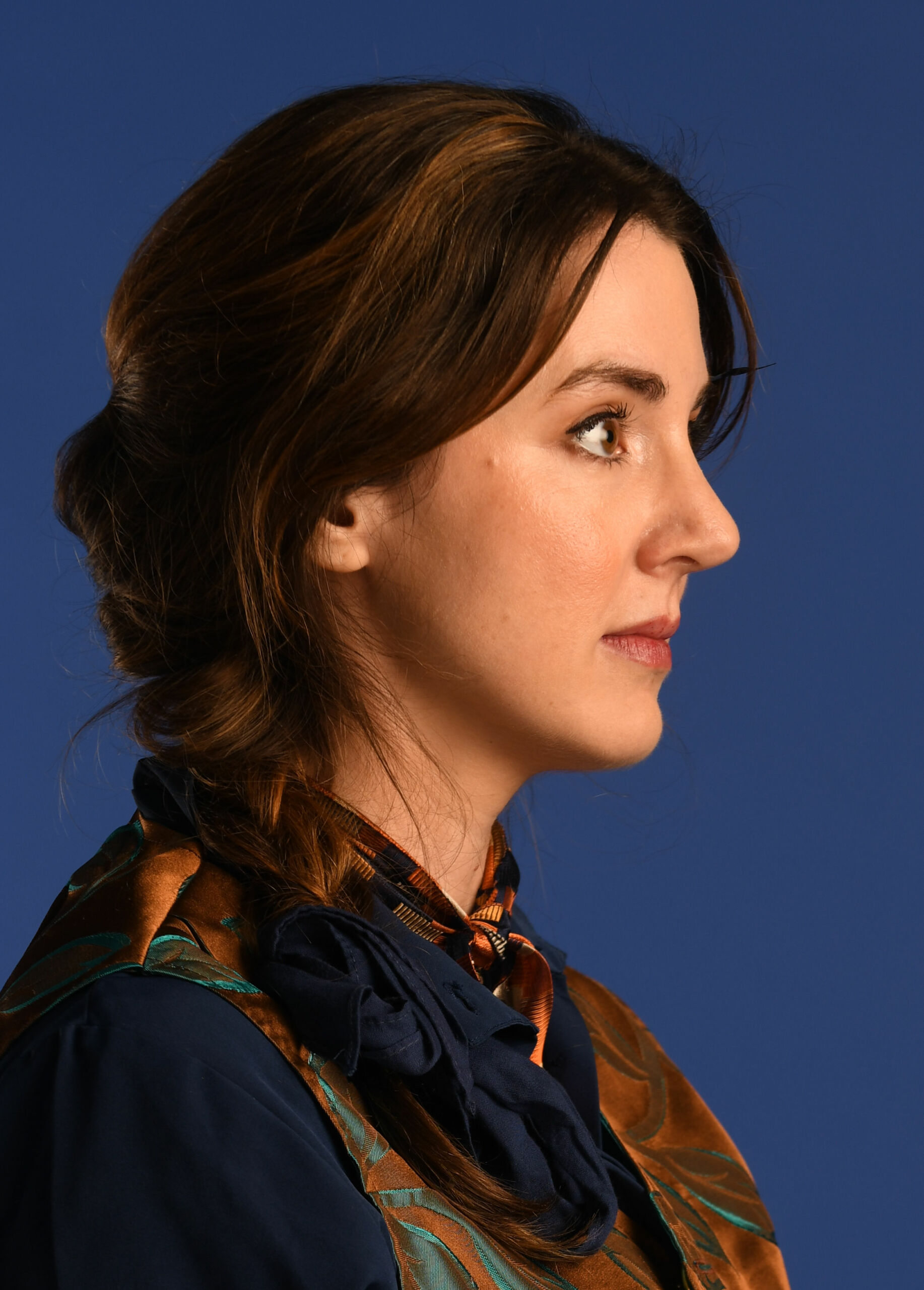
Original profile photo by Dave Lepori of Brenna Silva as “Jo”
Creating Artwork for Amy
Besides letters and telegrams, there is also artwork to be created. As a prolific sketcher myself, I’ve always been fond of Amy and her pursuit of art. For this show, all of Amy’s artwork is mine. The pictures she draws of her mother, played by Mary Melnick, and her sister Jo, played by Brenna Silva, are drawings I made based on their photographs, including one of the promotional photos taken by David Lepori of Brenna. I placed each photo on a light table and drew a sketch on top, to get the proportions right, then I scanned each sketch and printed it on heaver drawing paper, using artist’s drawing paper in both tan and grey. From there, I used colored pencils to complete my drawings.
Amy returns from Europe with a book of drawings that she gives to Jo. For this, I went back to my own sketchbook and found as many sketches as I could that looked like they could have been drawn during the period (this means mostly sketches of the outdoors or historical locations). Then I found period images of places that Amy might have visited – Venice, Paris, Lake Geneva, Amsterdam – and made my own pen-and-ink sketches of them. I printed all of these sketches on the tan and grey art paper, hand-colored some of them, and bound them into a leatherette book.
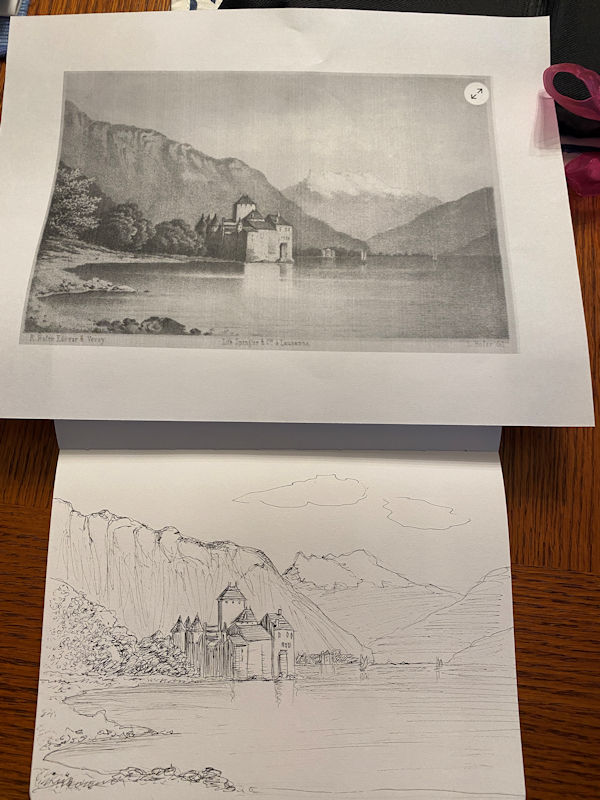
Sketching Chateau Chillon on Lake Geneva from an 1860s image
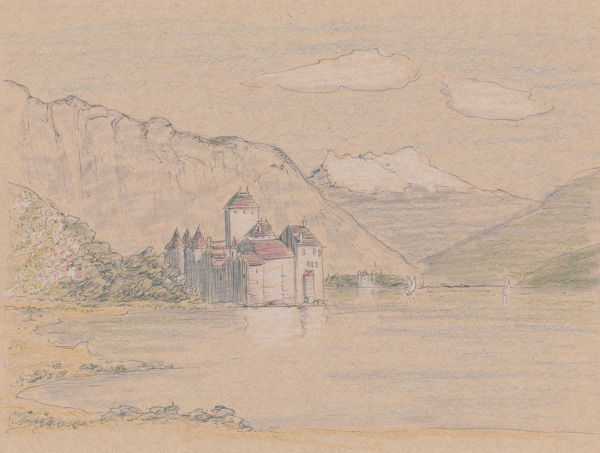
Sketch transferred to art paper and hand colored for Amy’s travel book
There’s been a lot of talk about the use of AI to create images and art. But SBMT has a formal AI policy that requires “human authorship” of the work in our shows. I am proud to say that I did not use any AI for any of the properties you will see in Little Women. I hope you will enjoy them all!
Leave A Comment