

 How do you design a place for characters with names like Queen Aggravain, Sir Studley, and Prince Dauntless to exist and breathe? It all starts, like everything else in theatre, with the story.
The characters and the plot of Once Upon a Mattress are exaggerated and fantastical, so the environment they inhabit should probably follow suit. After identifying major locations where the story takes place and speaking with the director, Doug Brook, about his vision for this world, a designer begins researching and developing concepts to make that vision achievable, practical, tangible, and inspired.
One of my jobs for this production was to design and build the set. I started with a questionnaire for Doug to fill out so I could better understand the story as seen through his eyes. He was interested in grounded fantasy worlds found in The Princess Bride, Highlander, and Robin Hood. As he described it, “The stony castle reflects the Queen’s stony attitude,” providing contrast to the other characters trapped in this world.
There needed to be plenty of space for large dance numbers. Perhaps a family crest incorporated. A battlement as a central motif. A base set supplemented by projections and wagons to signify location changes. This was more than enough to get to work.
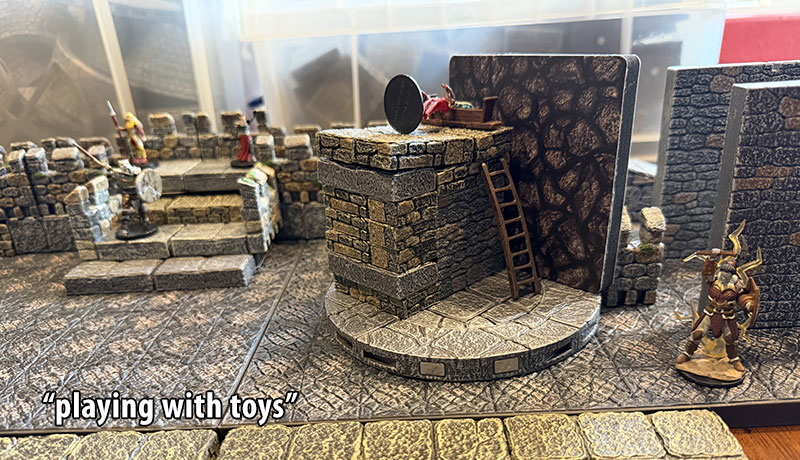
I always like to start designing by playing with “toys,” something physical I can move around, rearrange, and stack, allowing for happy accidents and inspired moments. Once I have some general concepts, I set pencil to paper to work out enough measurements to make sure the set, once built, will actually fit through the door into the theater, won’t hit the hanging lights, or interfere with the projections on the back wall.
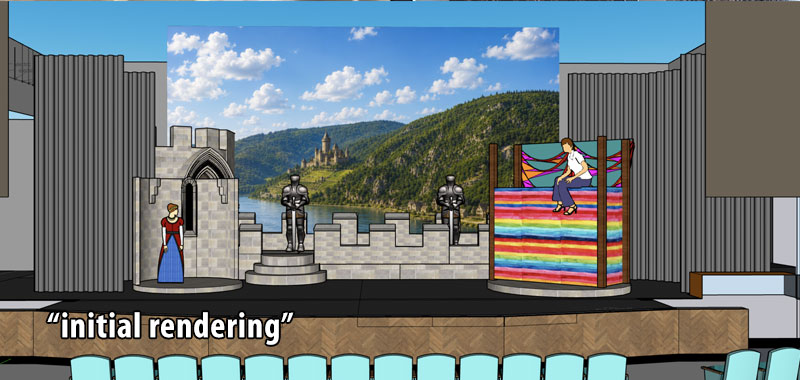
From there, I like to get the basic design into a digital program like SketchUp. This lets me better visualize the composition, examine sight lines, experiment with textures, and share the evolving design with the director and my fellow designers.
That is also when all the individual pieces of theatrical design really begin coming together. We aren’t creating separate things; we’re creating the same world.
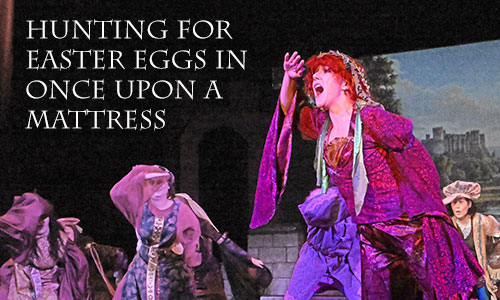
Lighting designer Noah Price, for example, had to figure out how to illuminate parts of the stage when I had inconveniently placed a giant tower in front of some of his lights. Properties designer Olivia Downey had the enormous challenge of building twenty “mattresses” that could be big enough and soft enough to be convincing, yet light enough and sturdy enough for choreography involving most of the cast. Costume, hair, and makeup designer Y. Sharon Peng had to create distinctive looks for every character while making costumes that evoked the period but still allowed the actors to move and dance freely. And projections designer Don Nguyen was so inspired by Melissa Jones’s take on Queen Aggravain that he decided to build the show’s visual world around the iconic woman-yelling-at-a-cat meme. He incorporated fire elements into the projections, inspired by the choreography and the music’s fiery, passionate, fun nature, creating environments that could transform from daylight to nighttime with whimsical contrasts against the coldness of the stone battlements.
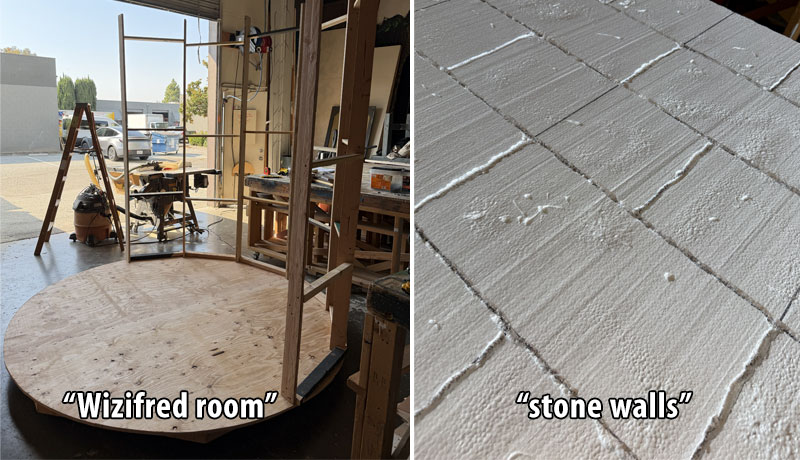
Which brings us back to the castle.
The base set consists of a long battlement stretching across the entire width of the stage and ending in a large tower with an archway leading down into the castle. Nearly all of it appears to be constructed from massive stone blocks. A large wagon doubles as both Winnifred’s room and the Wizard’s room, which Doug lovingly dubbed the “Wizifred room,” and another unit transforms from the throne room into the infamous bed with twenty mattresses. The medieval sconces were 3D-printed from open-source files.
The set is built primarily from wood, while the “stone” walls are polystyrene sheets that were individually carved and painted. The goal was to create a dimensional surface that, under different lighting conditions, would feel structural, heavy, and solid, an effect that is difficult to achieve with paint alone. Creating all that fake stone required many hours of handiwork, a task shared by me and Production Manager Emily Tao, our co-builder and scenic painter.
The bed/throne unit is mostly hollow, with a scaffolding skeleton surrounded by wood panels. I wanted the bed to be ridiculously tall for comic effect and to be a big visual payoff when the audience finally gets to see it. Because of that height, making the structure safe and secure was especially important, given everything Winnifred has to do on top of it.
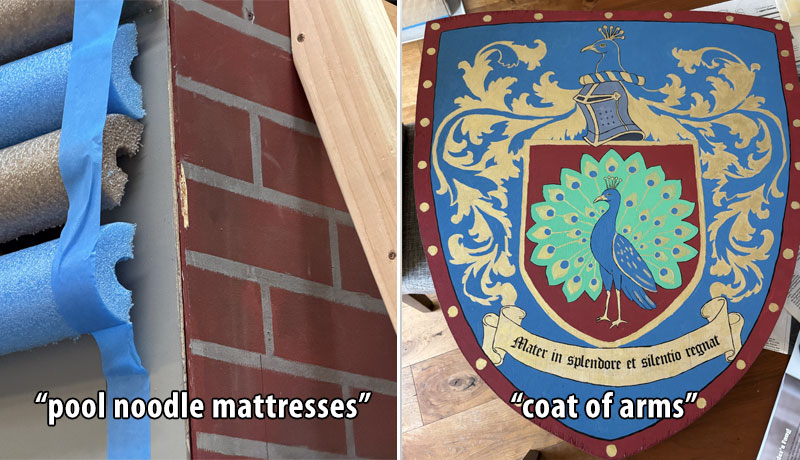
And those twenty mattresses? They are made from pool noodles cut in half, attached to wooden frames, and covered with different-colored fabrics to give each layer substance and personality.
Lastly, I designed a coat of arms for the kingdom using symbolism inspired by traditional heraldry. It includes a bird—a recurring motif throughout the production—as well as the Latin inscription “Mater in splendore et silentio regnat,” which loosely translates to “A mother rules with splendor and silence.” It is a relatively small detail, but those details matter.
If you’re looking for a creative outlet, want to learn something new, or simply want to put skills you already have to use, we are always looking for people to join our creative community. Complete this form, and we’ll get in touch.
And if you’d rather just see what all those people created, grab a ticket to one of the remaining performances and come visit our fairy-tale kingdom for yourself.
— Michael Paul Hirsch, Executive Director


Leave A Comment